
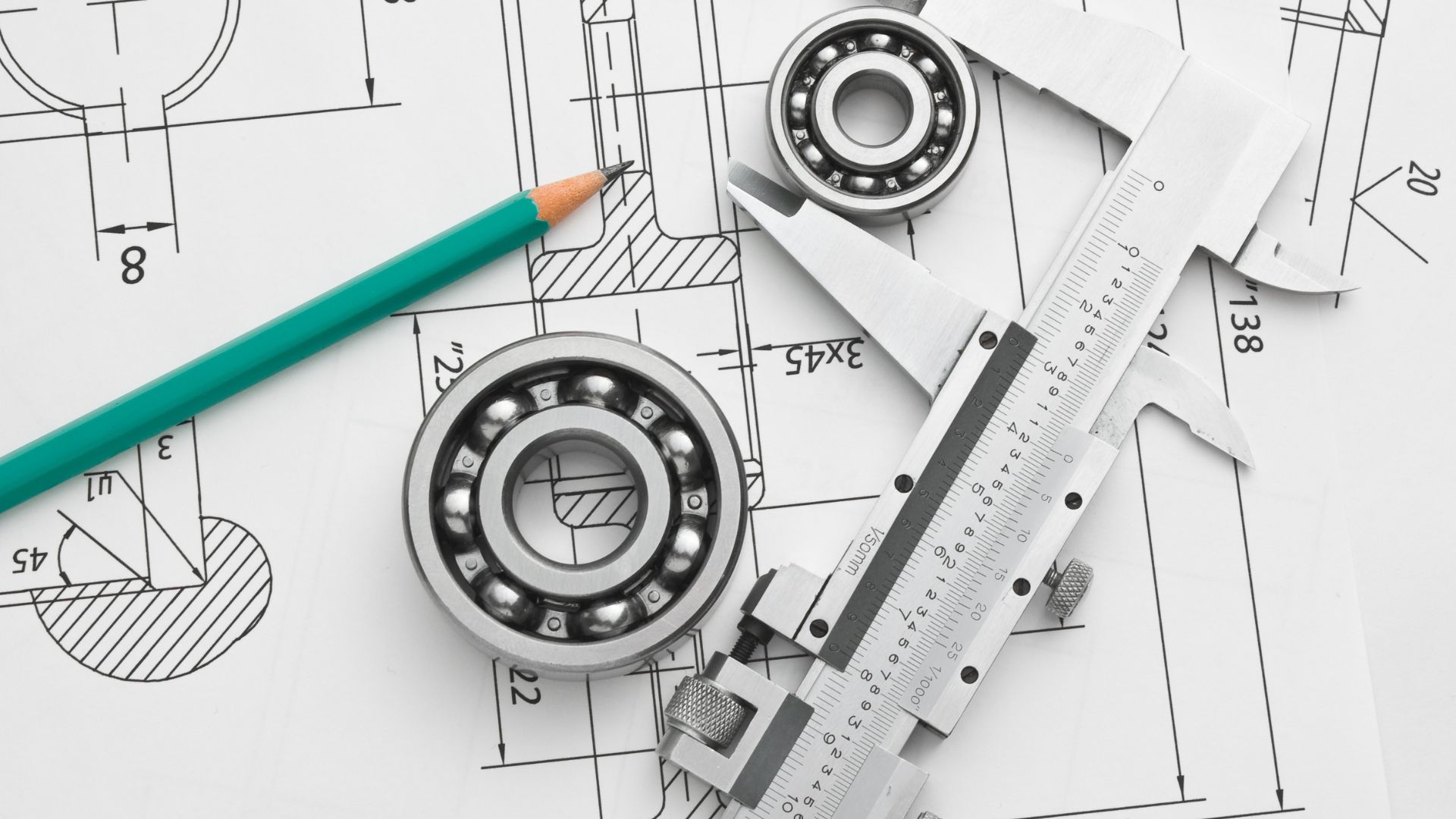
In today’s highly competitive manufacturing landscape, accuracy, consistency, and efficiency are non-negotiable. To meet these demands, industries across the globe rely on a powerful design language — Geometric Dimensioning and Tolerancing (GD&T).
GD&T isn’t just a set of symbols on a drawing; it’s a universal language of engineering that bridges the gap between design intent and manufacturing precision.
🔍 What is GD&T?
GD&T (Geometric Dimensioning and Tolerancing) is a symbolic system used to define the allowable variation in a part’s geometry. Instead of relying solely on traditional dimensions and tolerances, GD&T describes the form, orientation, location, and runout of features using standardized symbols and feature control frames.
It is governed by standards such as ASME Y14.5 and is widely adopted across aerospace, automotive, medical, and heavy engineering sectors.
🏭 Why GD&T is Crucial in Industry
1. Improves Manufacturing Efficiency
GD&T allows machinists and engineers to understand exactly what needs to be controlled, helping them avoid over-tolerancing or under-tolerancing a part. This reduces material waste, machining time, and inspection effort.
💡 “Make it right the first time, every time.”
2. Ensures Functional Fit and Performance
GD&T ensures that parts function correctly when assembled, even if they are manufactured by different vendors. This is critical in sectors like automotive and aerospace, where multiple parts must align and perform under extreme conditions.
3. Enables Global Communication
GD&T is a standardized language. Whether you’re in Germany, India, or the USA, a GD&T-compliant drawing means the same thing everywhere — reducing the chances of misinterpretation and costly rework.
4. Facilitates Advanced Inspection Techniques
Coordinate Measuring Machines (CMMs), vision systems, and other metrology tools are optimized to work with GD&T standards, enabling automated and accurate quality control.
🛠️ Common GD&T Symbols Used in Industry
| Symbol | Meaning |
|---|---|
| Ⓣ | True Position |
| Ⓕ | Flatness |
| Ⓒ | Circularity |
| Ⓗ | Hole/Feature Size |
| ⒪ | Concentricity |
| Ⓡ | Runout |
These symbols, combined with datums and tolerance zones, provide a clear definition of allowable variations in the final product.
🧰 Real-World Applications of GD&T
- Automotive: Ensures consistent fit of engine parts, gears, and assemblies from different suppliers.
- Aerospace: Maintains aerodynamic tolerances and critical alignments.
- Medical Devices: Guarantees precision in implants and surgical tools, where accuracy is life-critical.
- Tooling & Molds: Ensures proper mating of injection mold halves and die components.
🧠 Industry Insight: Why Engineers Prefer GD&T
Without GD&T, tolerances are vague and open to interpretation. With GD&T, engineers can:
- Communicate intent precisely
- Reduce inspection ambiguity
- Improve design robustness
- Minimize manufacturing costs
🎯 GD&T and the Future of Manufacturing
As manufacturing evolves toward smart factories and digital twins, GD&T plays an even greater role in enabling Model-Based Definition (MBD) — where 3D models carry all necessary information for manufacturing and inspection.
✅ Conclusion
GD&T is more than a technical requirement — it’s an industry standard that enhances communication, ensures quality, and drives efficiency across the entire product lifecycle.
Whether you’re a student, designer, quality engineer, or machinist, mastering GD&T is essential to excelling in the modern manufacturing world.